
AC not cooling? Get a licensed San Angelo repair pro today — diagnosed on site before any work.
📞 Call (325) 268-5114 Request a CallbackAC Repair · San Angelo, TX
AC Repair in San Angelo, TX
A broken air conditioner in San Angelo isn’t an inconvenience — with July highs averaging about 97°F and long stretches over 100°, it’s an emergency for your family and your home. Concho Valley HVAC‘s licensed AC repair technicians cover the Concho Valley — we diagnose the real problem, explain the full job up front, and fix it right — most common repairs finished the same visit.
This page explains what a repair job involves, what your symptoms usually mean, and what a proper diagnostic visit includes — so you can hire with your eyes open.
📞 Call (325) 268-5114 It’s an Emergency →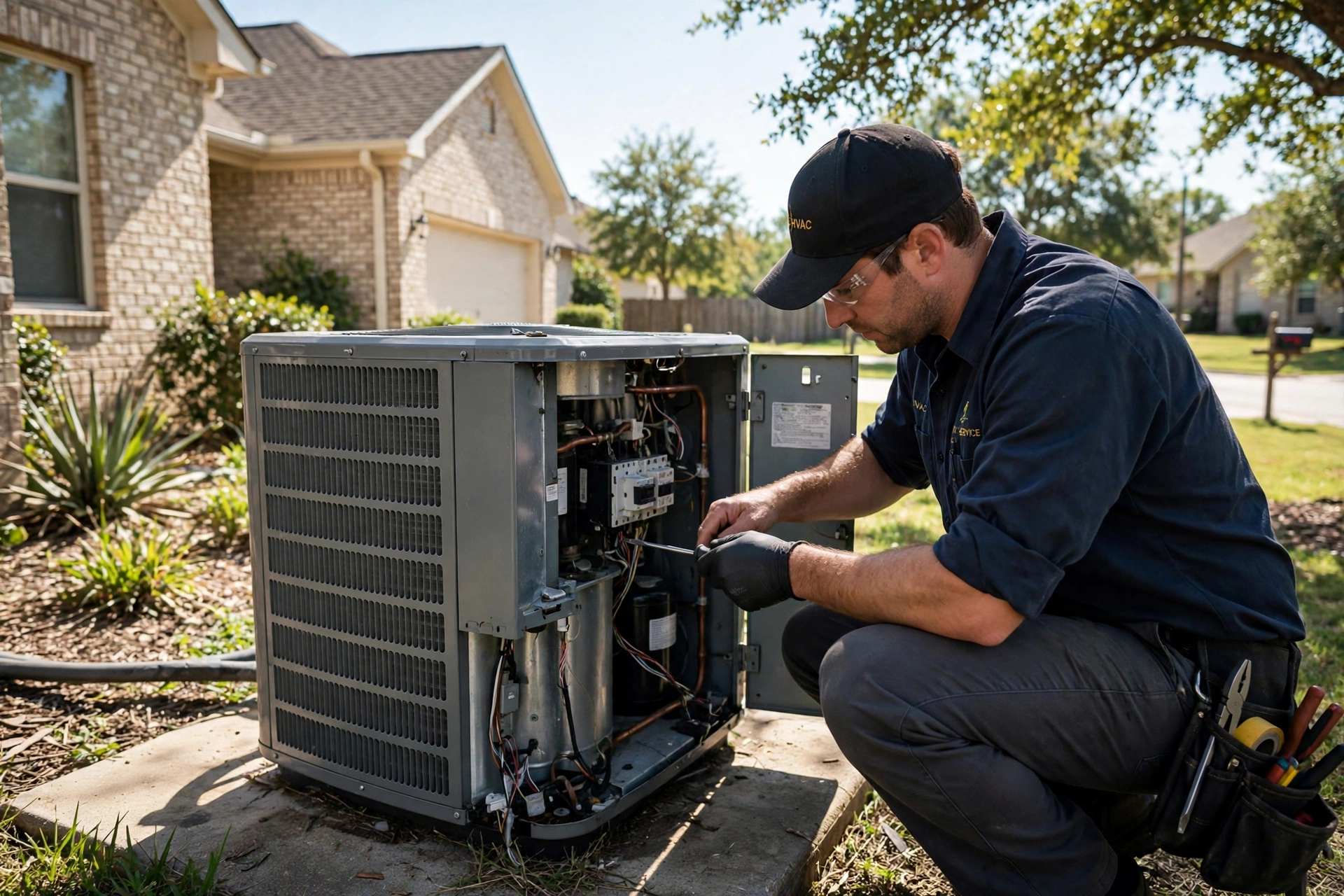
How Much Does AC Repair Cost in San Angelo?
Short answer: there’s no way to size up a repair before it’s diagnosed — where your job lands depends almost entirely on which part failed. A capacitor is a small fix; a compressor is the biggest repair there is. Your technician confirms the full scope after diagnosis, and you approve the work before it begins.
It starts with a diagnostic or service-call visit — any fee is explained before the visit is booked, and it’s often credited toward the repair if you proceed.
| Repair | What affects the job | Good to know |
|---|---|---|
| Capacitor replacement | One of the smallest parts in the system — usually one of the lowest-cost repairs | The most common failure on 5–10 year old systems; usually fixed in one visit |
| Contactor replacement | A small electrical part; the part itself and access drive it | Heat and constant summer cycling burn these out first |
| Refrigerant leak repair & recharge | Where the leak is, and which refrigerant your system uses (R-410A vs phased-out R-22) | Refrigerant never “runs out” — low charge means a leak that must be fixed, not just topped off |
| Fan motor replacement | Motor type (standard vs ECM) and your system’s size | Grinding or a dead outdoor fan points here |
| Thermostat replacement | The model you choose, from basic to smart | Sometimes the “dead AC” is a control problem, not a mechanical one |
| Control board replacement | Your brand, and whether the board is still made for your model | Boards take the brunt of constant cycling in Texas heat |
| Evaporator coil replacement | A major component — coil size, access, and refrigerant type | A leaking coil on an old system often tips the repair-vs-replace decision |
| Compressor replacement | The largest single part in the system; size and refrigerant type drive it | The biggest repair there is — compare it against replacement before deciding |
Why Is My AC Not Cooling? Symptom → Cause → Fix
If your AC is running but not cooling — or blowing warm air — one of these is almost always behind it. Find your symptom, see what’s likely wrong, and you’ll know what the technician is looking for before he arrives.
| Symptom | Most likely cause | The fix |
|---|---|---|
| Blowing warm air | Low refrigerant from a leak, or the outdoor unit isn’t running (capacitor/contactor) | Find and repair the leak, recharge to spec — or replace the failed electrical part |
| Runs all day, never reaches the set temperature | Dirty condenser coil, low refrigerant, or a system losing capacity with age | Coil cleaning, leak repair, or a proper capacity check |
| Weak airflow from vents | Clogged filter, failing blower, or leaky/undersized ductwork | Filter, blower repair, or duct sealing |
| Ice on the coil or refrigerant line | Frozen evaporator coil from starved airflow or low refrigerant | Thaw first, then fix the airflow or leak causing it |
| Short cycling (on/off every few minutes) | Refrigerant, airflow, or control problems — or an oversized system | Diagnose the root cause; don’t let it keep cycling |
| Water leaking inside the house | Clogged condensate drain — West Texas dust and algae cake drain lines fast | Clear and flush the drain; check the safety switch |
| Electric bills suddenly much higher | A struggling system working harder — dirty coils, low charge, worn parts | Full performance check; often one repair restores efficiency |
| Hissing sound + cooling drops fast | Active refrigerant leak | Turn the system off and call — leaks need EPA-certified handling |
One safety rule: it is not OK to keep running an AC that has ice on it, is hissing, or smells like burning. Running a frozen or leaking system strains the compressor — the most expensive part you own. Switch it off and call (325) 268-5114.
Signs Your AC Needs Repair
- Blowing warm air — the system runs, but the air isn’t cold
- Weak or uneven airflow — some rooms cool, others never do
- Won’t keep up — runs all day without reaching the set temperature
- Ice on the coil or lines — a frozen system is a system in trouble
- Water where it shouldn’t be — puddles at the air handler, ceiling stains
- Frequent cycling — on and off every few minutes
- New noises — grinding, squealing, banging, buzzing
- Musty or burning odors from the vents
- High humidity indoors even when the AC runs
- Sudden bill spikes with the same usage
In Concho Valley heat, a small problem on Monday is often a dead compressor by Friday. Catching these early is the difference between a small repair and a major one.
Check These 4 Things Before You Call
- The filter. A completely clogged filter can freeze a coil and shut cooling down by itself. If it’s gray and matted, replace it.
- The thermostat. Set to “cool,” fan on “auto,” temperature below the room reading. Dead screen? Try batteries.
- The breaker — once. If it tripped, reset it once. If it trips again, leave it off; repeated trips mean a real electrical fault.
- The outdoor unit. Is it running at all? Humming but not starting often means a failed capacitor — a classic, quick repair.
Still not cooling after those checks? That’s a diagnosis job, not a DIY job — refrigerant and high-voltage capacitors are licensed-technician territory.
What a Proper AC Repair Visit Includes
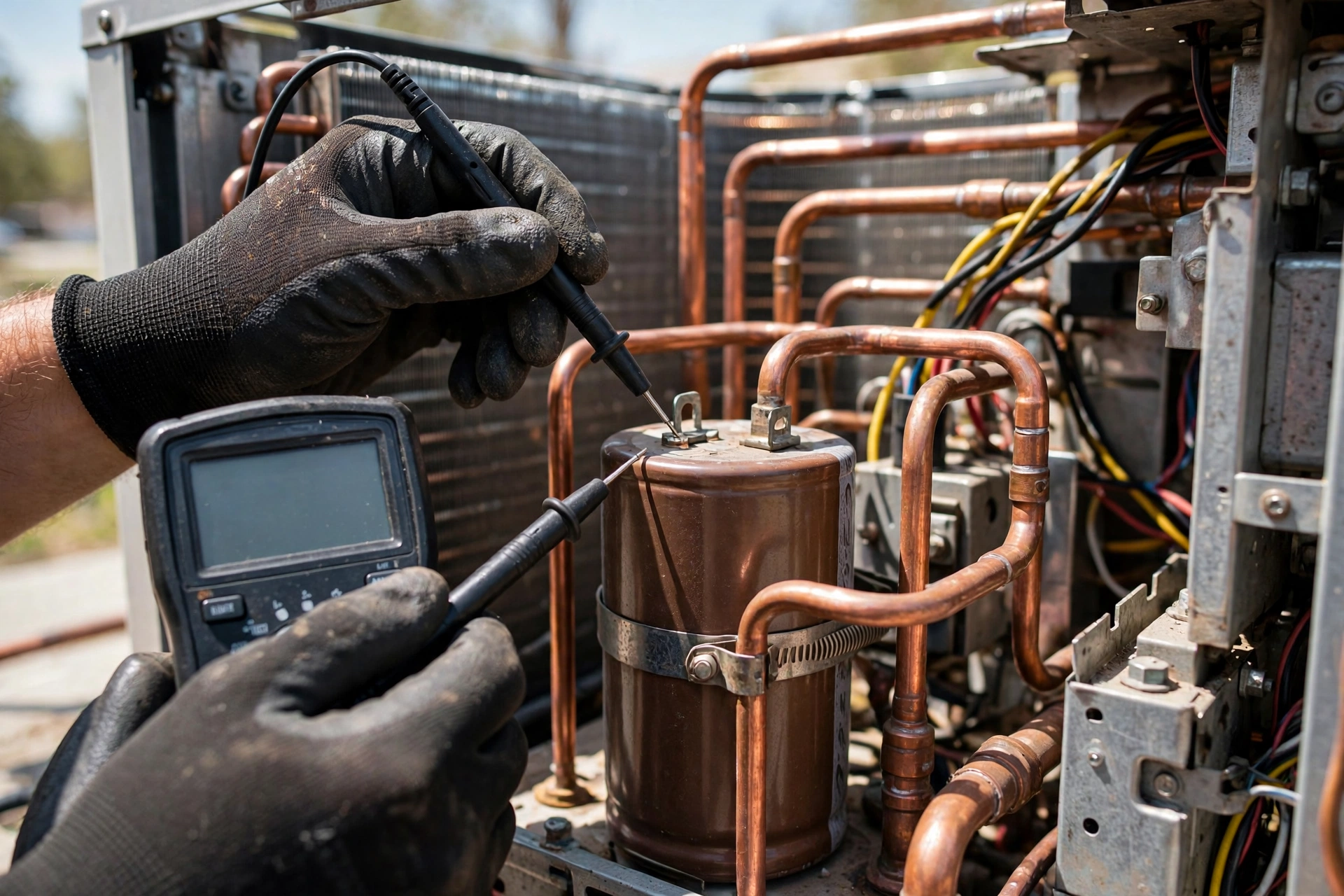
- A real diagnosis, not a guess. The technician checks refrigerant pressures, the temperature split across the coil, compressor amp draw, capacitor and contactor condition, coil cleanliness, airflow, and the thermostat and control board.
- The full picture up front. You see exactly what the repair involves and approve the work before it begins. No “we’ll see when we get in there.”
- The repair, done to last. Root-cause fixes with quality parts — not a band-aid that gets you through the week. Most common repairs are completed the same visit from parts on the truck.
- A full re-check. After the repair, the system is tested again to confirm it’s cooling to spec.
- A straight answer on what’s next. If the system is near the end of its life, you’ll hear that too — with numbers, not pressure.
Most straightforward repairs take one to three hours once the part is in hand, and same-day completion is the norm for the common failures — capacitors, contactors, motors, and controls. During extreme heat waves, no-cool calls are prioritized; call early in the day for the best shot at a same-day slot.
Repair or Replace? The Repair-or-Replace Rule
Multiply your system’s age in years by the repair cost, then compare that number with what a new system would cost you. If the two are in the same ballpark, replacement usually wins — you’d be pouring real money into a system near the end of its 10–15 year life. If the system is under half its expected lifespan and the repair is a common part, fixing it is almost always the right call.
Example: a 13-year-old system facing a compressor repair — the biggest job there is — almost always points to replacement. A 6-year-old system needing a capacitor points to repair, every time. Your technician will lay out both numbers for you. Weighing a replacement? See AC installation in San Angelo.
The Truth About Refrigerant
Refrigerant doesn’t get “used up.” If your system is low, it has a leak — and just topping it off buys you a few weeks before you’re low again. The right repair finds the leak, fixes it, and recharges to spec.
Know your refrigerant, too: older R-22 systems face phased-out, expensive refrigerant; most systems from the last decade run R-410A; and new equipment sold in 2026 uses R-454B, which is not interchangeable. If a coil or compressor fails on an older system, your technician will explain which options are actually open to you — before you spend anything.
AC Repair FAQs
How much does AC repair cost in San Angelo?
It depends on which part failed. Small electrical repairs (a capacitor or contactor) sit at the low end; a compressor or evaporator coil sits at the high end. It starts with a diagnostic visit — any fee is explained before booking, and it’s often credited toward the repair. The full job is explained, and you approve the work before it begins.
How much does it cost to replace an AC capacitor?
There’s no fixed answer — it depends on the part your system takes, and the job is confirmed after diagnosis, before any work starts. The capacitor is the part that helps your compressor and fan motor start; when it fails, the outdoor unit often hums but won’t start, or won’t start at all. It’s one of the fastest, most common repairs — usually done in a single visit.
Can a refrigerant leak be repaired, or do I need a whole new system?
Most leaks can be repaired — at a coil, a line connection, or a valve — and then the system is recharged to spec. A new system enters the picture when the leaking part is a major component on an old unit: an evaporator coil on a 12+ year old R-22 system, for example, usually makes replacement the smarter spend. Your technician will lay out both options side by side.
Should I repair or replace my AC?
Use the repair-or-replace rule: multiply the system’s age by the repair cost, and compare the result with the cost of a new system. If the two numbers are close, replacement usually wins; if the repair product is small next to a replacement, repair. Also weigh comfort: if the system can’t hold temperature on 100° days even when it’s “working,” or your bills climb every summer, a repair may just delay the inevitable. See our installation page for what a replacement involves.
How fast can I get AC repair in San Angelo?
No-cool calls are prioritized during the cooling season, and same-day service is the goal whenever one of our technicians has availability. Most common repairs are then finished the same visit. During extreme heat waves demand spikes across the whole Concho Valley at once — call early in the day for the best chance of a same-day slot, and call (325) 268-5114 any hour for a true emergency.
Do you repair all brands, and which areas do you cover?
Yes — our technicians service all major brands in West Texas homes, including Trane, Carrier, Lennox, Goodman, Rheem, Bryant, and Mitsubishi ductless systems. Coverage includes San Angelo, Grape Creek, Christoval, Miles, Wall, Carlsbad, Ballinger, and more — see our service areas.
Hot House? Let’s Fix That Today.
Licensed local pros, straight answers, and most repairs done the same visit.
📞 Call (325) 268-5114 Request a Callback